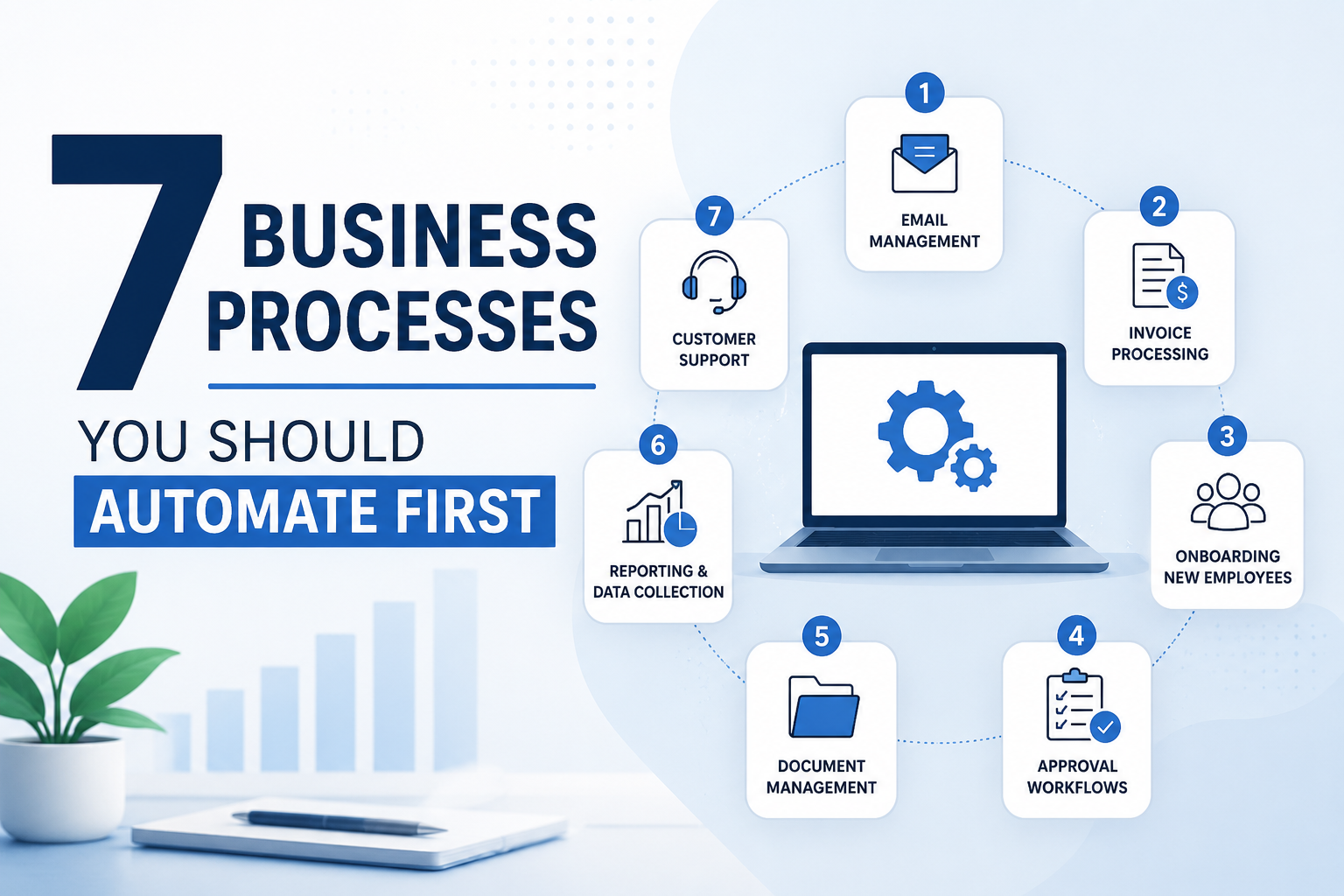
Everyone tells you to automate. Almost no one tells you where to start. So you end up with a list of fifty ideas, no clear first move, and the same manual work you had last month. The fix is to stop thinking about everything you could automate and pick the few processes that pay back fastest.
The processes you should automate first are the ones that run often, follow clear rules, eat real hours, and carry little risk if something needs a second look. This article gives you a simple rule for spotting them, then walks through seven proven starting points, each one a task that quietly drains time in most businesses. Pick one, prove it works, and the rest gets easier.
The case for moving is strong. In a Smartsheet survey, nearly 60% of workers said they could save six or more hours a week if their repetitive tasks were automated. That is most of a workday, every week, sitting on the table.
How do you know which processes to automate first?
The best first processes to automate score high on four things: frequency, repetition, time cost, and low risk. Run each candidate through these and the winner usually becomes obvious.
A process is worth automating early when it happens often, follows the same steps nearly every time, swallows real hours, and will not cause damage if the system occasionally needs a human to step in. Score your tasks against those four, and the boring, high-volume, rule-based ones float to the top. If you want the deeper version of this method, our guide on what AI workflow automation is and the full AI workflow automation guide both go further. For now, here are the seven that fit the profile in almost any business.
The 7 processes to automate first
1. Customer support and FAQ responses
Automate the repetitive questions first, because they are high-volume and follow clear patterns. A large share of support tickets are the same handful of questions asked a hundred ways: where is my order, how do I reset this, what are your hours. An AI chatbot can answer those instantly, around the clock, and pass anything genuinely tricky to a human with the context attached.
This is often the single highest-impact first automation because it touches every customer and frees your team from answering the same thing all day. Start here if support is where your hours disappear.
2. Lead capture and follow-up
Automate getting leads into your system and following up fast, since speed and consistency directly affect revenue. Leads arrive from forms, ads, emails, and social, and every one that sits unattended cools off. Automation pushes each new lead into your CRM, enriches it with company details, scores it, and triggers a timely first response.
No lead slips through a crack, and no rep wastes time on manual data entry. This pairs naturally with Lumen’s lead generation work, and it is one of the fastest paybacks for any sales team.
3. Customer onboarding
Automate the welcome-to-active journey, because onboarding decides whether new customers stay. The repetitive parts, welcome messages, document collection, account setup across your tools, progress nudges, all run cleanly on a workflow, while your team keeps the high-value conversations.
Done well, customers reach their first real result faster and churn less in those fragile early weeks. We cover the build in detail in how to automate customer onboarding with AI, which is a strong second or third project once support is handled.
4. Invoicing and payment reminders
Automate invoice creation, sending, and reminders, because billing is rule-based and cash flow depends on it. Recurring invoices go out on schedule, reminders chase late payments without anyone feeling awkward, and receipts file themselves. AI can also read incoming invoices and match them to orders, flagging only the exceptions.
The payoff is faster payments, fewer errors, and a finance task that no longer eats a Friday afternoon. It is one of the easiest wins on this list.
5. Data entry and syncing between tools
Automate moving data between your apps, because manual re-keying is slow, dull, and where most errors creep in. Every time someone copies a customer detail from email to CRM to spreadsheet, there is a chance to fumble it. A workflow keeps your systems in sync automatically, so the same record stays correct everywhere.
This one rarely feels exciting, which is exactly why it is so valuable. Removing silent data errors saves cleanup time you never see coming. Choosing an automation platform that connects your tools is the key to making it reliable.
6. Appointment scheduling and reminders
Automate booking and reminders, because the back-and-forth of finding a time is pure overhead. Let customers book into open slots themselves, sync it to every calendar, and send reminders that cut no-shows. When plans change, the system reschedules and updates everyone without a single email thread.
This is a classic first automation for service businesses, and many owners build it in an afternoon. It frees hours that were lost to coordination alone.
7. Social media scheduling and reporting
Automate posting and reporting, because they are repetitive and run on a predictable rhythm. Schedule content ahead, publish it automatically across channels, and pull engagement numbers into a report without copy-pasting from five dashboards. AI can also draft and adapt posts for each platform, leaving you to approve rather than create from scratch.
Marketing stays consistent even in your busiest weeks, and you get your reporting time back. It connects directly to AI digital marketing, where this kind of automation does the heavy lifting.
What you should NOT automate first
Some processes look tempting but make poor first projects, and starting with them sours the whole effort. Steer clear of these until you have a few wins behind you.
Do not automate a broken process, because automation only makes a bad workflow run faster. Fix and document it by hand first, then automate the working version. Skip one-off tasks that run a few times a year, since the build cost never pays back. Keep high-trust work, like pricing negotiations, sensitive complaints, and anything legal, with a person who can read the situation. And avoid automating a process that is still changing every month, or you will be rebuilding it constantly. As McKinsey’s 2025 State of AI report found, the real returns come from redesigning a process around automation, not bolting it onto a broken one.
How to automate your first process
Once you have picked one process from the list, the path to a working automation is short. Keep the first version narrow and prove it before you expand.
- Write down how it works today, including the awkward edge cases, so nothing hides.
- Choose a tool that connects to your existing apps, your CRM, email, and billing, so it fits your stack rather than adding a new island.
- Build the simplest version that works, not a giant workflow that tries to do everything.
- Test it on real data, using genuine messages, leads, or invoices, not tidy demo inputs.
- Keep a human checkpoint on anything sensitive until the results earn your trust.
- Measure the time and errors saved, then move to the next process on your list.
This is especially worthwhile for small businesses, where every reclaimed hour shows up immediately. If you would rather have the first flow built correctly from the start, Lumen’s workflow automation service handles the design and build for you.
Frequently asked questions
What business process should I automate first?
Start with the process that is high-volume, repetitive, rule-based, and low-risk. For most businesses that means customer support FAQs, lead capture and follow-up, or invoicing. These run constantly, follow clear patterns, and free real hours quickly. Pick the one quietly eating the most of your team’s time, automate it well, and use that win to justify the next project.
How do I decide which tasks are worth automating?
Score each task on four factors: how often it runs, how repetitive it is, how many hours it costs, and how risky a mistake would be. High-frequency, repetitive, time-heavy, low-risk tasks pay back fastest. Rarely-run, judgment-heavy, or constantly-changing tasks usually do not. The boring, predictable work is almost always the best place to start.
Should small businesses automate the same processes first?
Yes, the same profile applies, and small teams often benefit most because they have the least spare capacity. Support replies, lead follow-up, invoicing, and scheduling are strong starting points that need no large budget or engineering team. The advice is identical: start with one high-frequency, low-risk process and expand once it runs reliably.
Do these automations need AI, or just rules?
It depends on the task. Steps that move data on a fixed schedule, like sending an invoice or syncing records, often need only simple rules. Steps that read messy text or make judgments, like sorting support tickets or drafting replies, benefit from AI. Most strong workflows combine both: rules for the movement, AI for the decisions.
How long does it take to automate a process?
A single, well-defined process can often be built and tested in a few days, sometimes an afternoon for something simple like scheduling. Processes that span several systems take longer, usually a week or two including testing. Starting narrow keeps the first project quick and lets you prove the value before scaling.
What is the most common automation mistake?
Automating a messy or undefined process. If three people do the same task three different ways, automation just locks in the inconsistency at speed. The fix is to clean up and document the process by hand first, then automate the version that actually works. Starting with the tool instead of the process is the close runner-up.
Pick one and start this week
The businesses that win with automation do not begin with a grand transformation. They start with one process, usually something dull and repetitive, prove it works, and build momentum from there. Any of these seven is a strong first move.
If you want help choosing and building the right first automation, explore Lumen’s workflow automation service or book a free automation call. We will look at your most time-consuming process and show you exactly what automating it would save.